

trrau.over-blog.com/
24 Janvier 2021

To format a hard drive means to erase any information on the drive and to set up a file system so your operating system can read data from, and write data to, the drive. You need to format a hard drive if you plan on using it in Windows. A collection of hard drive formatters programs for Windows 7, Windows 8 and Windows 10 along with software reviews and downloads for 32-bit and 64-bit titles. Drive formatter software Hard drive format utility for use with Samsung NTFS and FAT32 drives. Free Freeware 913.07 KB 10 / 8 / 7 / V / XP. Full version Free Trial 552.71 KB 8 / 7.
What is quick format and what is full format? Does either quick/full format erase all data? Many computer users may not have clear concept about these. This article will explain the differences between quick format and full format and provide advice on how to choose between them.
A Full Format runs an additional step that checks the hard drive for any bad sectors. This check is what makes the full format take so much longer than a quick format. Unfortunately, like the quick format, the files still exist and the volume could be re-built to gain access. Nov 19, 2020 format fs=fat32 quick or other desired file system. Then, the disk will be formatted. Limitations of Windows native disk formatting utility: They cannot format a large hard drive (which is bigger than 32GB) to FAT32 file system. They cannot format an internal hard drive to exFAT file system while exFAT is generally ideal for flash drives. Formatting a hard drive is the best way to start from scratch on a geeky project. You'll want to do it before you sell your machine, for sure, but it's also one of the steps you take when you.
As we mentioned in What Is Disk Formatting, the whole disk formatting process consists of three parts: low-level formatting, partitioning, and high-level formatting. The formatting operated by computer users is high-level formatting. And this formatting is operated on partitions.
However, the high-level formatting is specifically divided into two modes in the actual operations: quick format and full format (it is also called general format).
The differences between quick format vs. format often make computer users confused. A good knowledge about them will help computer users make best use of disk.
First, let's take formatting in Windows Explorer and Disk Management as examples. When computer users format a partition, quick format is checked by default. If they uncheck quick format, full format mode is selected automatically.
Windows Explorer
Open File Explorer and right click a local disk under This PC. Then click Format.
Disk Management
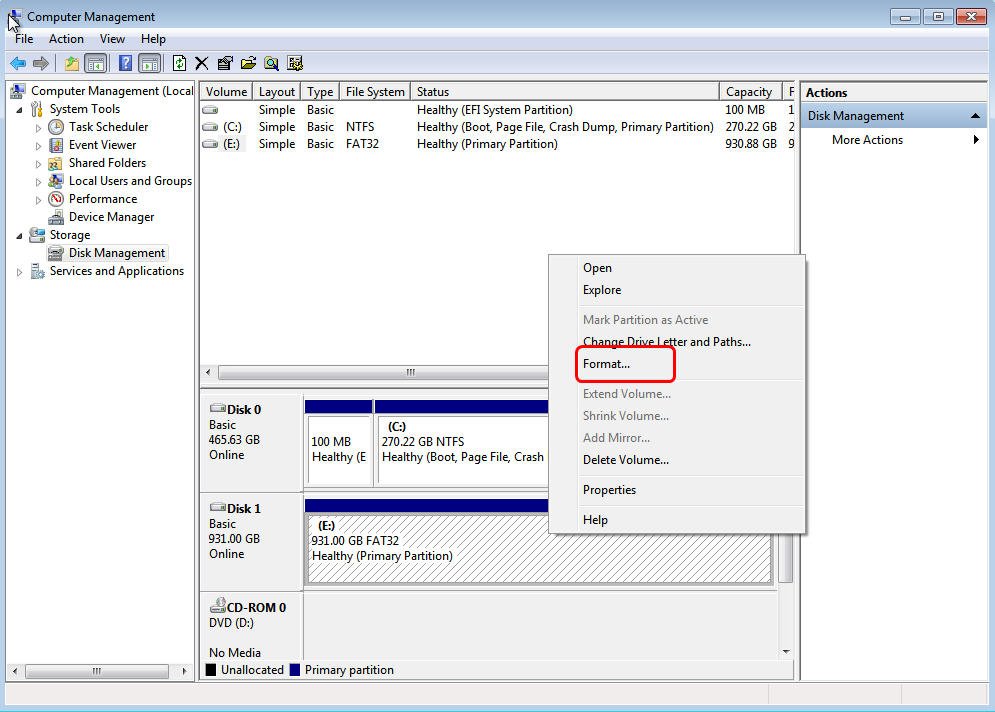
Press 'Windows + R' keys and then type 'diskmgmt.msc' to open Disk Management. Then, right click a partition and select Format.
In addition, computer users can also use diskpart command to perform quick/full format. Press 'Windows + R' keys and type 'cmd' to open the cmd window. Then, type 'diskpart' to open diskpart window. Type 'list disk', 'select disk *', 'list partition', 'select partition *' to locate the partition to be formatted.
Type 'format fs=ntfs quick' to carry out quick format. Type 'format fs=ntfs' to perform full format.
What is the difference between quick format and full format? Does quick/full format erase all data? Many people are concerned about these questions. To figure out these problems, computer users must know what happens when they format partition with quick format vs. full format.
Quick format will 'delete' files from the partition and rebuild the file system, volume label, and cluster size. It is faster than full format. However, it's not the real sense of formatting.
Pay attention that I used the word 'delete', not 'erase'. That means that quick format doesn't really erase all the data.
It just marks the partition as 'formatted' and destroys the journal that keeps tracks of the files and their locations on hard drive. So, the data is still on the hard drive and it can be easily recovered by a data recovery software before it is overwritten.
Full format will clear files completely from the partition, rebuild the file system, volume label, and cluster size, and scan partition for logical bad sectors (that's why full format is slower than quick format). It is the real sense of formatting and that's why some people are afraid of it.
In Windows with the versions Windows XP and earlier, full format just had the additional bad sector scanning function compared to quick format. That means that data can be easily recovered in these Windows operating system even if full format is performed.
But full format is changed in Windows Vista and later Windows versions, it will erase original data, write zeros to the whole partition, and finally erase zeroes again to avoid the possibility of data recovery. So, full format does erase all data.
Generally speaking, data that is fully formatted (in Windows Vista and later Windows versions) will not be able to be recovered by data recovery software. However, some people still think that data can be recovered with more advanced technology through the residual magnetism on disk.
Then, how to make data unrecoverable to guarantee users' data recovery? Many people may wonder about that.
If a computer user has fully formatted a disk, it's difficult for him to recover data with civilian data recovery software. But he can recover data easily if the disk is performed with just quick format.
MiniTool Partition Wizard can also help to recover data. Here is the tutorial.
Step 1: Buy MiniTool Partition Wizard and launch it to get its main interface. And then click Data Recovery on the toolbar.
Step 2: Double click the formatted partition G or select it and click Scan to start scanning.
Only check the file type of files that I want to retrieve.
Step 3: The scanning result is shown as the following picture. Then, I need to find the picture.
Attention:
Step 4: Select the file and click Save.
Sometimes, computer users may accidentally format a partition and cause the computer to not boot anymore. Or, computer users may mistakenly install Windows (which sometimes will format the target disk) and also cause the computer to stop booting.
If these situations happen, how to recover data from quick formatted disk when computer can't boot? Fortunately, MiniTool Partition Wizard can also solve this problem.
Here is the tutorial.
Step 1: Buy MiniTool Partition Wizard and launch. And then click Bootable Media on the toolbar.
Step 2: Click WinPE-based media with MiniTool plug-in, and choose the media destination.
Step 3: Set the firmware to make the computer boot from the USB or CD/DVD.
Step 4: Use Data Recovery feature as shown above to retrieve data.
How to make data unrecoverable? Many people who want data privacy will want to know the answer to this problem. They don't want any of their data to be abused in case the data gets retrieved by other people; this could cause bad consequences in all aspects of their life.
Some people would like to sell or donate the disk if they don't need it anymore. So, the worst method is to damage disk physically, which will make the disk unusable.
The common method is to fully format a disk or to wipe it. As mentioned above, computer users can use Windows Explorer and Disk Management to full format a disk. However, it still has risk of having data being recovered by others.
To avoid such a problem, I recommend the Wipe Partition feature (free) of MiniTool Partition Wizard to wipe data completely.
Here is the tutorial.
Step 1: Download MiniTool Partition Wizard and launch it to get to its main interface. Right click the partition you want to wipe and select Wipe Partition.
Step 2: Select wiping method.
Attention:
1. Fill sectors with Zero and Fill sectors with One: They are similar to full format in Windows. They just write the same code to the partition.
2. Fill sectors with Zero &One: It will randomly write zeros and ones to partition, which has more advanced data privacy than full format.
3. DoD 5220.22-M (3 passes): It is a data erasure standard of the US Department of Defense (DoD). The data erasure standard states that data on a hard drive should be overwritten multiple times for proper data sanitization. This wiping method has three passes.
4. DoD 5220.28-STD (7 passess): It is also a DoD data erasure standard. Adobe premiere pro login. It provides the highest security level for data and has more passes than the above DoD 5220.22-M (3 passes).
Step 3: Click Apply button to execute the wiping operation.
The above wiping operation with MiniTool Partition Wizard can guarantee enough data privacy and usable disk at the same time.
Generally speaking, if computer users don't need to scan disk for bad sectors or they don't want to wait for a long time, they can choose quick format in case that they need to recover data someday.
Quick format can be performed in the following specific situations: clear partition with unnecessary files to free up space, install Windows, the file system is damaged and the notification 'You need to format the disk before you can use it. Do you want to format it now?' occurs, and so on.
Full format is performed usually because computer users don't need the data anymore and don't want it to be recovered by others. Or, when computer users want to check the disk for bad sectors, they will consider full format.
Full format is performed in the following specific situations: get a brand-new unformatted disk, the disk is old and has many bad sectors, decide to sell or donate the device, computer get virus, and so on.
But if computer users decide to sell or donate the device, they usually don't want the data to be recovered by others. Then, they could use DoD 5220.22-M (3 passes) or DoD 5220.28-STD (7 passess) mode in MiniTool Partition Wizard to guarantee the data privacy better.
Can you benefit from this article? Or does this article explain quick format vs. full format well? You can leave a comment below for sharing or to discuss with us. If you have problem in data recovery or wiping partition, please email us at [email protected] for help.
What does formatting a hard drive do? Have you ever asked yourself? The first idea occurs to you might be data loss, but that's not all. Brief introductions to disk formatting, the purpose of formatting a hard drive, as well as how to format are talked in this post of MiniTool. To know the details, please read the article with attention.
What is formatting? Formatting a hard drive means to delete all the data on the drive and set a file system to prepare an available space for the operating system. Disk formatting is the process of preparing a data storage device such as a hard drive, sloid state drive for initial use. Formatting can be divided into three parts.
In some cases, formatting can also create one or more new file systems. The first part of the formatting process that performs basic media preparation often considered as 'low-level formatting'. Partitioning is a generic term in the second part of the process that makes data storage device visible to the operating system.
The third part of the process, often referred to as 'advanced formatting', usually refer to as the process of generating a new file system. In some operating systems, all parts or certain parts of the process can be combined or repeated at different levels. Therefore, the term 'format' should be understood to mean the operation of the new disk media to fully prepare the file for storage.
If not specified, hard disk formatting refers to high level formatting, while floppy disk formatting usually contains two formats at the same time. Does formatting a disk erase data? No, format is not the same as erase. You are unable to recover your data after erasing it, while there's chance to find it back after formatting.
As most hard disks have been formatted at the factory, formatting is only required when the hard drive media has errors. Do you want to know what does formatting a hard drive do? If you don't know, keep reading.
What does format mean to you? Protect your privacy by deleting your private information or cause data loss? In fact, things are not as simple as they look like on the surface. If you have some benefits because of the formatting operation, what are they? On the contrary, if it does harm to you, what's the result?
Here are some things you need to know about formatting a hard drive. There are two most direct effects of formatting a hard drive. The first one is that you can remove all the data on your hard drive, while the second one is that you are able to change file system to NTFS/exFAT/EXT2,3,4.
Besides, there are some other effects of formatting hard drive.
Let's analyze its effects one by one.
One of the most direct effects of formatting a drive is that all the data on the drive will be removed. As a result, you may lose your important data. Hence, making sure your data has been backed up before formatting the drive is crucial.
You may have noticed that you can select the file system when you format a hard drive. That means you can change you file system by formatting the drive. When you need to change your drive's file system from NTFS to EXT2/3/4, you can format it.
If you operate this on Windows Disk Management, you cannot finish this operation. Here comes the need of a third-party software to do this. Here, MiniTool Partition Wizard is strongly recommended to you. This software allows you to format a drive to NTFS/exFAT/EXT2,3,4 easily.
Formatting a hard drive can improve the performance of your computer. Actually, the performance improvement of computer is mainly by cleaning up disk space, cleaning system file and deletion harmful programs.
When computer's the hard drive is formatted or reformatted, all the data on the disk will be erased completely and a new copy of the operating system will be reinstalled. Even though all the operating system files are copied to the formatted hard drive, you still can notice that there is relatively large available space on it.
The extra space results from the formatting process, during which deletes previous unnecessary system files on the hard disk drive. Computer runs faster and performs well when there is more available space. Hence, formatting hard drive can improve the performance on data storage.
After using the computer for a long time, files and codes that run the operating system might be damaged greatly slowing many functions of computer. Hard disk utility programs can clean and fir those files sometimes, but the easiest method to improve performance is to execute a full hard drive format and reinstall all necessary files recovering them to the undamaged condition.
Formatting a hard drive can improve your computer performance through deleting harmful programs during the process. You cannot always notice computer virus and other malicious software, but they might roam the system hard disk and damage some important files.
Spyware and virus are harmful to computer's whole performance. Though virus scanning program and other utility programs can help you delete those malicious projects, they are not always successful.
Reformatting hard disk drive will delete all the files on the computer including harmful files to restore the system to the optimal performance.
Why formatting is necessary? After reading the above text, you might know the reasons.
However, if you format a hard drive accidentally, thus lose all your data, things are totally different. To find the data back, you need a professional tool. Here, MiniTool Partition Wizard is strongly recommended.
Its Data Recovery feature enables you to retrieve your data very easily as long as you don't make any change to the formatted hard drive. It's impossible to recover the data in a formatted hard drive with newly written data.
To know more information about hard drive recovery, please take this post as a reference: Hard Drive Recovery – Recover Lost Data and Restore Lost Partitions
There are three methods for you to format a hard drive: the third-party software - MiniTool Partition Wizard, Disk Management and DiskPart. All of them are convenient to operate and simple, so just choose one as you like. Specific steps to each method are shown as follows.
Formatting a hard drive is rather convenient in MiniTool Partition Wizard. It is a professional partition manager with some powerful features such as: Data Backup, Disk Benchmark, Partition Recovery, etc.
Here is the guide to format a hard drive with MiniTool Partition Wizard.
Step 1: Launch MiniTool Partition Wizard to get its main interface. After choosing the target hard drive to format, click the Format Partition feature from the action panel.
Step 2: After setting the partition label, file system for the partition, click the OK button to continue the process.
Step 3: Finally, click Apply to execute the pending operation.
You are able to format a hard drive on Windows through Disk Management. If you don't want to use a third-party software, Disk Management is a great choice. Next, I will show you the detailed steps to format a hard drive.
Step 1: Press Windows and R key at the same time to open the Run window. Type diskmgmt.msc in the window, and then click OK.
Step 2: If it's a new hard drive, you need to initialize it before using it. Just as the picture shows. Single click the drive and then select Initialize Disk.
Step 3: Initialize the disk as MBR (Master Boot Record) or GPT (GUID Partition Table). After that, click the OK button to go on.
If it's not a new drive, things are different. Select the Format feature after right clicking the target partition.
Step 4: Set the volume label, file system and alloction unit size for the partition. Otherwise, it will carry out the operation according to the default settings. Then, click OK.
Step 5: Click OK in the pop-up window to finish the formatting operation.
DiskPart allows you to format a hard drive, too. It's a simple tool to format a hard drive because you can achieve it just by typing some commands.
Step 1: Press Windows plus R key simultaneously to get the Run window. Type diskpart in the windows and then click OK.
Step 2: Type a series of commands on the DiskPart page. Press the Enter key after typing each command. The following are commands:
For more information about hard drive formatting, please read this post: How to Format a Hard Drive with Ease in Windows 10/8/7?
After reading the post, you must have a deep understanding of disk formatting and why do you need to format your drive. What does formatting a hard drive do? You may know the answers now.
Methods to format a hard drive are also provided for you. So, if you would like to format your hard drive to improve computer's performance or for other reasons, you can choose one from the given methods randomly.
If you encounter any problem or have any question and suggestion to the formatting a hard drive issue, please send an email to [email protected] or leave a comment below.
Nov 23, 2020 • Filed to: Answer Hard Drive Problems • Proven solutions
A computer's hard drive experiences malfunctions over time, which are caused by multiple factors like viruses, or sketchy or incompatible software, or the computer's old age. To help maintain and resolve performance issues, reformatting the hard drive every year is advisable. In this article, we will learn how to format the hard disk in Windows 7. If in case you forget to create a backup of your files, then we will show you how to recover those files.
Windows 7, introduced many user-friendly features with its release. One of them was revamping the method to format the hard drive on the go by adding the freshly minted Disk Management utility. It allowed the user to create partitions and format the hard drive with ease. Here in this section, we will discuss everything related to disk formatting on Windows 7.
Disk formatting permits the user to remove the used storage from the storage device altogether and also helps in managing one or more new file systems. It can also be used to check for faulty tracks or defective sectors within a hard drive.
Formatting is the process of setting up/preparing a storage device for first use, which includes main on-disk structures initialization, partitioning (dividing disk space into segments), and executing another file system's tasks.
Formatting can be done on almost every kind of storage device like a Hard disk drive, USB flash drive, external hard drive, and an SSD. Before formatting any type of hard drive, we recommend that you should form a backup of all the crucial files present inside the storage device. The backup will allow you to open and use the data again after the formatting is finished.
There may be multiple factors behind formatting a storage drive, we will discuss some of those reasons in this section of the article.
There are two types of formatting procedure that the computer may ask you to choose, which we will discuss briefly:
The quick formatting process is used to make the formatting process quick. This method does not check the drive for bad sectors, so you must only opt for this method if your purpose is just to clear some space in the HDD. The major disadvantage of this method is that the data doesn't get completely wiped out so if your drive is still causing problems after the quick format, then you should perform a full format scan on your hard drive.
A Full Format is recommended if you believe that your computer is infected with malware and viruses. This method checks the hard drive for bad sectors, and it usually takes longer to erase data than a quick format.
If your drive is misbehaving and performing sluggishly, then you must perform a full format on your HDD. It is a better option to make sure no issues exist with the drive. You can initiate the formatting process by simply unchecking the 'Quick Format' tab and then clicking on Start.
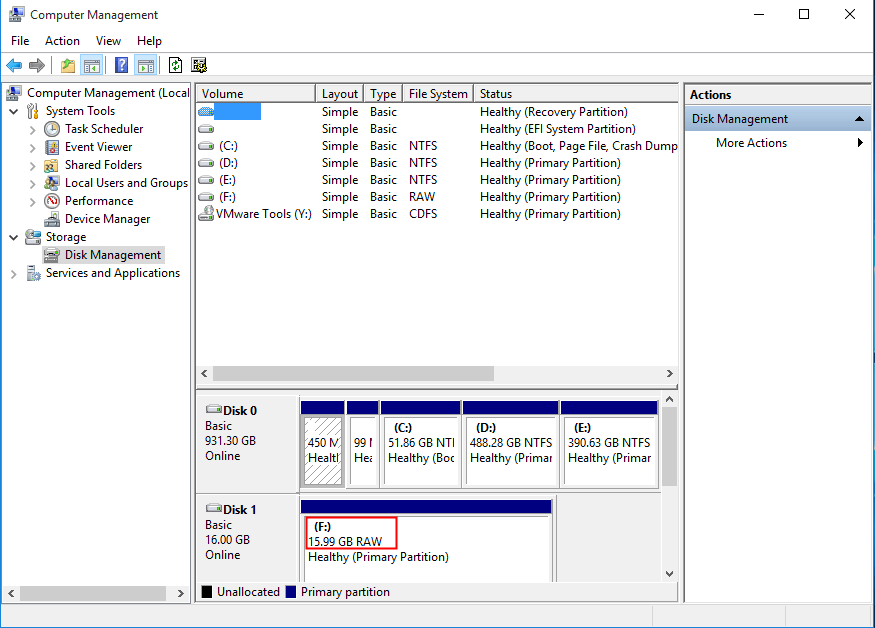
The Disk Management Utility offers you the full management of the disk-based hardware(HDD) recognized by Windows, which also includes an external storage source. At the bottom end of Disk Management, you can see the graphical representation of the physical drives installed in your computer. Disk Management is the place that allows you to create and attach virtual hard disk files in Windows OS. You can create single makes, which acts like a Hard Drive, which offers you to store data on them from the primary hard drive or any other location like an external hard drive.
You can format your Hard disk drive with the help of Disk Management. The utility is an inbuilt Windows tool that can be used to perform the following functions:
If you are preparing to perform a reformat on your computer's hard drive, then you must take necessary precautions before moving forward with the process. The formatting method will erase absolutely everything on the disk if you don't make the right arrangements. Here are the things that you must do before cleaning the hard drive.
Reformatting is the method of erasing the used space of a disk drive or the entire storage device. Such a scenario arises if you want to use a Mac-based disk with a Windows computer, you would need to reformat it using a Windows-compatible file system that would be the FAT32.
Here in this section, we will discuss the method to format and reformat a volume of the hard drive through the disk management utility.
After formatting a hard drive, you will find that the software program conflicts or glitches that were causing problems on your PC will disappear, and the computer's performance will improve significantly. You can perform this procedure on any kind of USB flash drive and external hard drive.
New volumes are created if you intend to create new partitions or change the size of your volume. For example, if you have recently installed an SSD on your computer, then you will find an unallocated storage space where the previous version of your Windows OS was stored. You can create and format a new disk volume on a hard disk, with that unallocated disk space on your computer's hard drive.
Please follow our guide to create a new volume by assigning it a new name and formatting it.
After formatting your hard drive and losing all the data as a result, if you intend to use those files again, then there is a way to recover all of that data back. But, you should not save any new information on the formatted hard drive, or it will be overwritten entirely, so it is extremely essential to perform the recovery operation as soon as possible.
You can recover your data by using data recovery software on your PC. We recommended that you use the Recoverit Data Recovery software for Windows to restore deleted files from the formatted hard drive in Windows 7.
Features of Recoverit:
After installing the app, you are required to launch it from the Start menu by searching Recoverit and double-clicking on the icon. From there, you are required to follow our three-step process to recover deleted files.
After the Recoverit data recovery software for windows is opened on the computer, then please follow the steps mentioned below:
Formatting a drive on Windows 7 is an easy as well as fast, which saves the user both time and money. If in case your hard drive gets infected with some virus, then you must perform a full format on your drive. Now you know the way to create and delete partitions on your Windows PC by using the disk management utility. Formatting the disk means that your data will get erased with no trace, but Recoverit by Wondershare allows you to recover that data if you ever feel the need to use it again.


/image%2F6318774%2F20210124%2Fob_2077cd_adobe-cs4-raw-plugin.jpeg)
/image%2F6318774%2F20210124%2Fob_663475_starcraft-xbox-one.jpeg)
/image%2F6318774%2F20210124%2Fob_29bc9f_roblox-studio-windows-10-download.jpeg)
/image%2F6318774%2F20210124%2Fob_23b444_acrobat-reader-windows-8.png)